

[Blog post] telecom as the middleware stack: orchestration of virtualization & oversubscription of core operations
This is my first post in a series that will detail my progress in implementing an end-to-end open-source configuration-defined Telecom Operator. The Operator will be designed to be all the features and functions, both internally and externally, in a unified and completely abstracted service model. I named the result the "Telecom as the Middleware Stack" as a form of expressing that it becomes the service it provides and is reduced to a consumer of everything and anything that it can communicate as an adaptive version of one overall amazing experience.
Imagine a tablet that, depending on who's holding it, adapts its purpose. In one person's hand it's an enterprise's CRM experience; in someone else's hand its an IPTV set-top-box; another's: a portal to live cameras; and another's: the live network map of fiber and copper in the ground within 10 feet of where their standing. Imagine that tablet is simply an interface that can be anything, to anyone, simply based on authentication, authorization, policy, and governance; a completely adaptive experience delivered all by a single device.
We can imagine that quite easily because the tablet has evolved to be just that: an adaptive blank slate. Now image that same experience with every digital service, every electronic device, in every conceivable layer of service delivery, and for every desired experience that a Telecom Operator could provide, all from a single Service Provider: that is the promise of the integration of NFV, SDN, IoT, and the Telecom as the Middleware Stack approach. That is what I want to outline and explore in this series.
The goal of the journey of this series is to:
- Reduce Telecom Operator costs associated with closed, legacy, and/or proprietary IT.
- Increase productivity through experience architecting the multi-tenant, multi-purpose usability.
- Entrench technology-agility, real-time intelligence, and market-viability.
- Mitigate risk of vendor, technology, or strategy lock-in.
- "Open" every door for innovation from internal and external perspectives.
The strategy to obtain that goal is to:
- Develop and expose the entire TMForum process-standards, application-frameworks, and API reference-models into centralized Governance Model, Multi-Tenant/Purpose Policy Engine, and API Manager.
- Abstract and integrate the wiring-harnesses of network function virutalization (NFV), software defined networking (SDN), and internet-of-things (IoT).
- Utilize WSO2's unified product stack to implement as much of the integration, governance, policy enforcement, complex event processing, and user experience as possible, but no more than that.
- Decoupling of systems from user experience and marrying them back adaptively via policy.
- Introduce "open-source" principals to the experience architecting aspect.
The intended result is:
- One unified strategy, a single elastic implementation, redefined as an infinite number of adaptable marketable experiences: "Orchestration of Virtualization & Oversubscription of Core Operations"
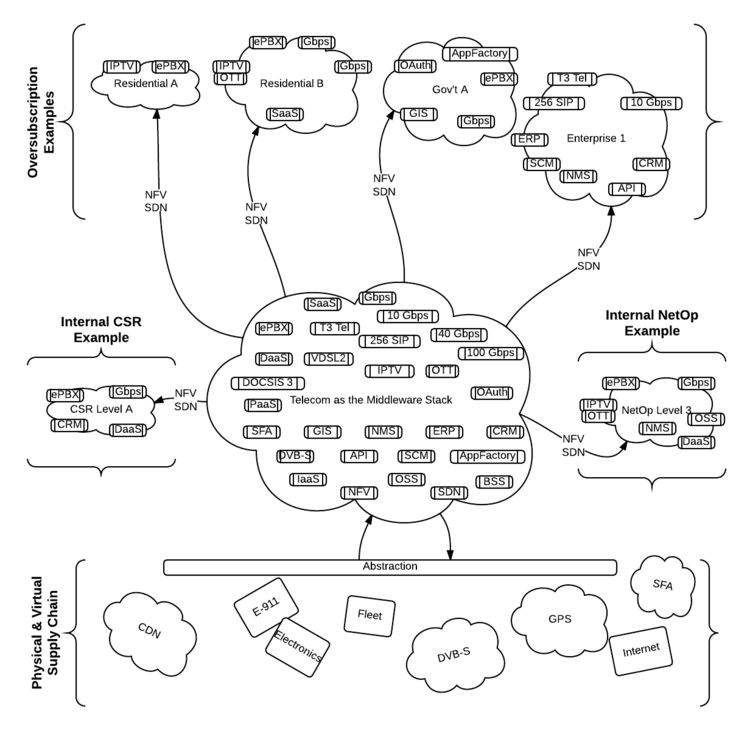
Figure 1 - Telecom as the Middleware Stack | Examples of one implementation oversubscribed as many different experiences to many different communities of users.
Refer to Lance's blog.