


Overview
Previously Matsushita Electric Industrial Co., Ltd., Panasonic Corporation is a large Japanese multinational electronics corporation based in Kadoma, Osaka. Knosuke Matsushita began the company in 1918 as a lighting socket producer. In addition to consumer electronics of which it was the world's largest maker in the late 20th century, Panasonic's product and service offerings include rechargeable batteries, automotive and avionic systems, industrial systems, and home renovation and construction.
Panasonic has recently designated India as a regional hub to promote growth and make deeper inroads into the fast-emerging economies of Asia, the Middle East, and Western Europe. Starting in India, the company hopes to develop the know-how to address Indian consumers and then transfer that knowledge to growing markets.
Our IoT Cloud Architecture, which intends to onboard and control millions of IoT equipped devices, relies heavily on WSO2 Identity Server. It is a true open source software that provided us with the much-needed momentum to quickly build user authentication services and bring our platform to market early without implementation challenges. We were able to deploy crucial APIs with minimal latency given the architecture recommendations and product optimizations. Its multi-tenancy support aids us in developing an IoT platform-as-a-service for our corporate customers.”
Challenge
With India's GDP predicted to rise to 8.2% in 2023, the country's purchasing power is on a steady upward trajectory. The number of internet users is predicted to reach close to 700 million by 2021, and close to 1 billion by 2025. By 2022, India's smartphone population is expected to reach 820 million. Because it is the world's youngest country, with almost 45% of the population under the age of 25, the learning curve for embracing newer technologies will be minimal.
These figures suggest that the Indian market is well-positioned to integrate IoT-enabled appliances into the consumer electronics sector. Consumers do not desire one-size-fits-all appliances. They want the appliance's features and behavior to be tailored to their preferences. For example, "I want my air conditioner to adjust the temperature overnight so that I may sleep comfortably." When consumers are away from home, they want to be able to see and manage their air conditioner. "Did I turn off my bedroom air conditioner before leaving home?" or “It's a scorching hot day. I wish I could turn on my air conditioning before I get home.” Consumers also want to be notified if there are any safety or security concerns when they are away from home. “How do I leave a message for the courier when I am not at home?”
The rising needs of the Indian consumer resulted in the launch of MirAIe, which is a technology-enabled platform catering to consumers’ comfort, convenience, connectivity, and safety requirements. As the scope for smart living spaces continues to grow, Panasonic India is uniquely positioned to capture the market. With the launch of MirAle, Panasonic India wanted to address the following areas:
- The number of appliances/devices and users connecting to the platform will grow in the millions as the platform grows in popularity, so the user management system must be both scalable and secure, with very low latency.
- With a vast number of devices connected to the platform, the volume of data streaming will be large, and the platform will need to be scalable to analyze the data.
- The ability to support multi-tenancy when the platform is extended for PAAS (Platform as a Service) solutions
- Advanced data security and consumer privacy protocols
- The ability for customers to operate their appliances through a variety of channels (smartphone apps, voice assistants, chatbots, etc.).
Solution
Panasonic India has had a clear plan to establish an IoT platform based on open source software that implements open standards (OAuth, OpenID Connect, REST, etc), which is also broadly community adopted and is a cost-effective, long-term solution.
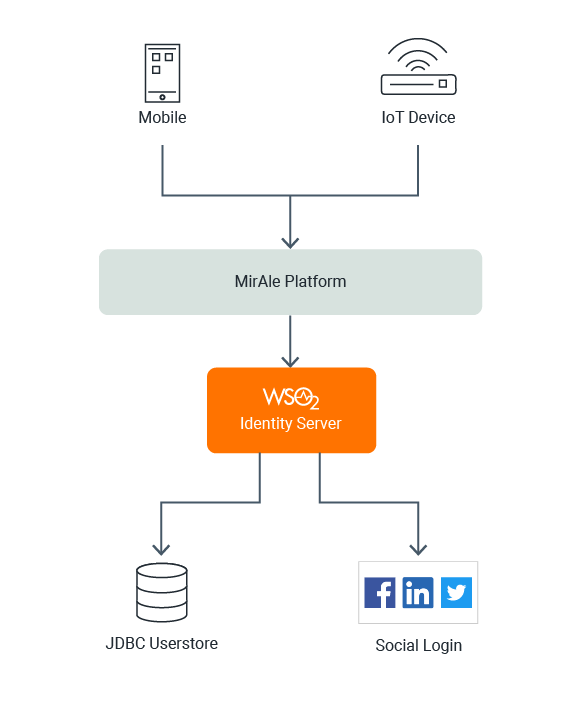
Identity and access management (IAM) was the mission-critical component of the required platform that supports key features including user authentication via different methods (local user database and social logins), claims management, OAuth service provider management, token management, and tenant management.
The solution should allow the end-user to select their login key – mobile, email, or username – in order to log in to the IAM interface and acquire an access token to make further API calls in a timely manner. To control access to platform functionalities, the system should be able to support granular RBAC (Role-based access control) implementation. Finally, the chosen IAM solution should be extremely stable, require minimal maintenance, be highly scalable, have low latency, and excellent security.
After reviewing many product offerings, Panasonic India chose Choreo Identity & Access Management because it is a pure open source platform with simple licensing terms, flexible architecture, extensive scalability matched with 24/7 assistance from Choreo Labs Support, and its cost-effective nature.
The MirAIe IOT platform is a microservices architecture-based cloud-native solution.
Mobile apps and devices connect to MirAIe, authenticate with Choreo Identity & Access Management using credentials, receive an OAuth access token, and utilize it to connect via REST interfaces and MQTT (Message Queuing Telemetry Transport). When an end-user onboards their newly acquired appliance to the MirAIe platform, these devices/appliances are generated as new users in Choreo Identity & Access Management.
After a successful OTP (One Time Password)validation, mobile applications can self-register in the platform using the user's mobile number. The OAuth token's expiry duration is short and tokens are rotated regularly, and tokens are associated with specific scopes to eliminate the risk of misuse.
To enable high availability and speed, the IoT platform leverages many Choreo Identity & Access Management nodes that run behind an application load balancer (ALB). To maintain data confidentiality, the load balancer is set with a TLS v2 industry-standard SSL digital certificate.
Results
The platform has a standard method of identifying and authenticating user entities, which has aided in the rapid evolution of the MirAle platform and the provision of improved customer experiences to end-users.
MirAle has been able to register and manage various application entities as service providers in Choreo Identity & Access Management, as well as manage the lifecycle of OAuth tokens with various expiry times and policies based on platform requirements. It is now simple to introduce a new digital application channel, and its user identification and security can be controlled independently.
MirAle has now developed more than ten categories of IoT-enabled products using this solution, as well as expanded the business by offering MirAIe as a platform as a service with multiple tenants. This year, the organization plans to introduce more product categories. Choreo Identity & Access Management manages hundreds of thousands of user identities and thousands of concurrent users and devices connected to the platform simultaneously.
Choreo Identity & Access Management helped Panasonic India to create and manage administrative users, claims, OAuth service providers, and tenants through a simple user interface. It also includes scripts for token cleanup automation. Overall, the effort required for operation and maintenance is minimal.
Choreo Labs support remained a critical success factor in the project's implementation. Even amid a global pandemic, the support team scheduled security architecture reviews and developer workshops to kickstart the implementation process. The team suggested architectural features such as social login and performance enhancements including multi-attribute password-based login.