WSO2 is now Choreo LabsLearn more

Trusted AI Governance
Build

Create agents and AI apps with the tools and languages your teams already use.

Connect

Link agents securely to your APIs, data, models and business systems.

Run

Deploy, observe and operate agents and AI apps reliably at any scale.

Govern

Control identity, access, cost and policy for every agent in production.

Agent Management

Developer Platform

  • API Management Cloud

    Design, secure and publish APIs with governance and analytics built in.

    Sign Up Now
  • Integration Cloud

    Connect apps, data and AI agents with low-code and pro-code integration.

    Sign Up Now
  • Identity & Access Management Cloud

    Secure sign-in and access for customers, partners, workforce and agents.

    Sign Up Now
  • Agent Management Cloud

    Build, run and govern AI agents with full visibility and control.

    Sign Up Now
  • Developer Platform Cloud

    Ship cloud-native apps faster on an internal developer platform.

    Sign Up Now

Self-Hosted

Full control over your stack. Deploy directly to your own servers, bare metal, cloud, or Kubernetes environment. Your data never leaves your perimeter.

Product Downloads
Choreo Labs
AI Governance
Platform
Solutions
Resources
Blog

OAuth and authentication type: application vs application user

On the 3rd step of editing APIs in WSO2 API Cloud, you can set required authentication type for each resource:
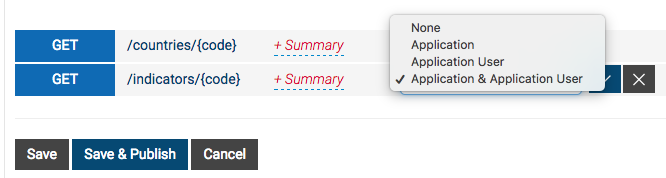
We have already covered None as the option to allow invoking APIs without any authentication whatsoever.  Today we will discuss the other options.

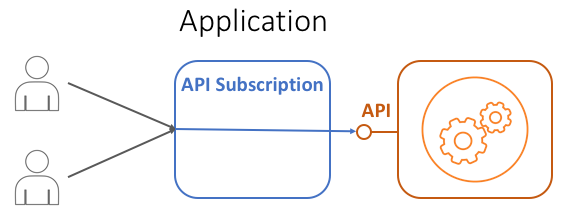
Application type means that the API will require OAuth tokens generated with client grant type. That grant type produces tokens specific to the subscription but not the end-users.

So if there is a web- or mobile application that subscribed to this API and it has multiple end-users, they will all be sharing the same token and the API backend will not "know" which end-user is invoking the API:
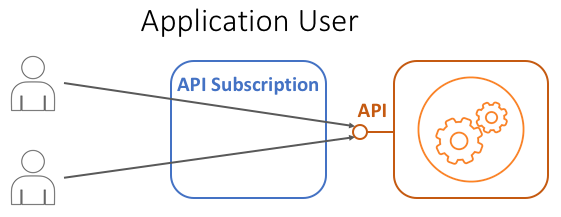
Application User type means that the API accepts OAuth tokens generated with password grant type. These tokens are specific to the end-user - they require not just the application key but also end-user's username and password.

In this case, each end-user gets their own OAuth tokens even though they are using the same API subscription. API Gateway then generates a JWT token and uses it to pass application and user information to the API backend:
Application and Application User type means that both kinds of tokens are acceptable by the API.